General
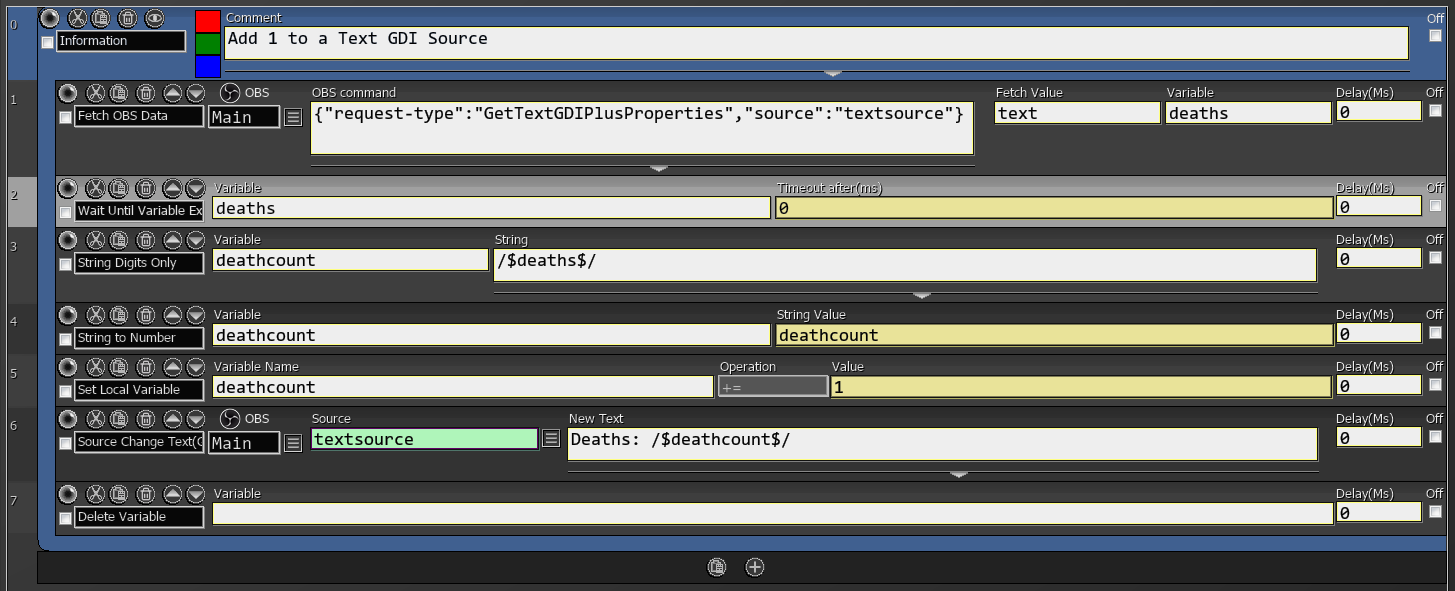
Allows you to request data from OBS websocket and save it in a variable.
The requested value will always be inside an object called responseData (for OBSws 5), but may be inside a second object. You can access it with object dot notation.
For example, if you want to retrieve the Brightness value from a Colour Correction filter, you will notice that it is inside an object called filterSettings. { "filterEnabled": true, "filterKind": "color_filter_v2", "filterSettings": { "brightness": 0.078 }, "filterIndex": 0.0 }. In this case, the Fetch Value will be responseData.filterSettings.brightness.
Use JSON string validator if you want to make sure your formatting is correct.
Be mindful of any trailing commas in your request that will cause OBS to disconnect, such as:
{
  "op": 6,
  "d": {
    "requestType": "GetVersion",  // this trailing commma must be removed
  }
}
Use the dropdown arrow next to the OBS Command (JSON) box to make use of the premade templates to assist you (OBSws 5 only).
(Filter.Transform.Rotation.X).
| Box Name | Type | Description |
|---|---|---|
| OBS | Dropdown | OBS to send this command to (if using multiple OBS connections). |
| OBS Command (JSON) | JSON String | JSON String to send to OBS Websocket. You can use the dropdown to select a JSON template for each request (OBSws 5 only). |
| Fetch Value | String or object | Name of a value you wish to get. Leave blank to fetch the whole object. For values inside another object use object dot notation. For values inside an array use index position. |
| Save Variable As (optional) | String | Name of a variable to save the data under. |
Send OBS Request Examples (OBSws 5)
| What to retrieve | OBS Command | Fetch Value |
|---|---|---|
| current CPU usage | {"op":6,"d":{ |
responseData.cpuUsage |
| Time elapsed since streaming started | {"op":6,"d":{ |
responseData.outputTimecode |
| Scene Item ID of a source | {"op":6,"d":{ |
responseData.sceneItemId |
| Current width of a source | {"op":6,"d":{ |
responseData.sceneItemTransform.width |
| Current text in a GDI source | {"op":6,"d":{ |
responseData.inputSettings.text |
| Brightness value of a Colour Correction filter | {"op":6,"d":{ |
responseData.filterSettings.brightness |
| First source name in a specified scene | {"op":6,"d":{ |
responseData.sceneItems[0].sourceName |
Similar to ‘Trigger Pull Data’ command, but for OBS Websocket 5 Events.
This command will return a response from the OBS Event Trigger that was used.
More information about all possible OBS events can be found in Official OBS Websocket Documentation.
| Box Name | Type | Description |
|---|---|---|
| Save Variable As | String | Variable name where the value will be saved to. |
| Pull Value | Dropdown | Select value from the dropdown list. Typing all will return the full response object. |
Enables or disables studio mode in your OBS.
| Box Name | Type | Description |
|---|---|---|
| OBS | Dropdown | OBS to send this command to (if using multiple OBS) |
| Enable | Checkbox | Checked = enable studio mode, unchecked = disable studio mode |
OBS WebSocket 5 Request: SetStudioModeEnabled
| Request Field | Type | Description |
|---|---|---|
| studioModeEnabled | Boolean | true to enable Studio Mode, false to disable it. |
Activates any OBS hotkey without having to manually press it.
You can find the unique name of a hotkey in one of these two locations:
- For general hotkeys:
basic.inifile inC:/Users/USERNAME/AppData/Roaming/obs-studio/basic/profiles/YOUR_CURRENT_PROFILE - For source-specific hotkeys:
YOURSCENENAME.JSONfile inC:/Users/USERNAME/AppData/Roaming/obs-studio/basic/scenes
Once you open the file, look forHOTKEYSunder each source which should have all your unique hotkey names listed.
| Box Name | Type | Description |
|---|---|---|
| OBS | Dropdown | OBS to send this command to (if using multiple OBS) |
| Hotkey Name | String | Unique name of the hotkey |
OBS WebSocket 5 Request: TriggerHotkeyByName
| Request Field | Type | Description |
|---|---|---|
| hotkeyName | String | The internal OBS hotkey name (e.g. libobs.mute). |
| contextName | String (optional) | The name of the input/scene context to trigger the hotkey for (required for source-specific hotkeys). |
Executes hotkey routine.
Does not actually perform the key presses, it simply activates any hotkey action you’ve set.
| Box Name | Type | Description |
|---|---|---|
| OBS | Dropdown | OBS to send this command to (if using multiple OBS) |
| Key ID | String | Main key ID. It must be the OBS name for it, such as OBS_KEY_A. All OBS hotkeys can be found in OBS Studio’s documentation. |
| Ctrl | Checkbox | Whether to include Ctrl key |
| Alt | Checkbox | Whether to include Alt key |
| Shift | Checkbox | Whether to include Shift key |
OBS WebSocket 5 Request: TriggerHotkeyByKeySequence
| Request Field | Type | Description |
|---|---|---|
| keyId | String | OBS key identifier (e.g. OBS_KEY_A, OBS_KEY_F1). Full list at obs-hotkeys.h. |
| keyModifiers | Object | {"shift": false, "control": false, "alt": false, "command": false} — modifier key state. |
Example: keyId = "OBS_KEY_F5" with keyModifiers = {"shift": true} triggers Shift+F5.
Controls the OBS Virtual Camera — Start, Stop, or Toggle it using the dropdown.
| Box Name | Type | Description |
|---|---|---|
| OBS | Dropdown | OBS to send this command to, if using multiple OBS connections. |
| Action | Dropdown | Whether to Start, Stop, or Toggle the Virtual Camera. |
The OBS Virtual Camera creates a virtual webcam device that other applications (Zoom, Discord, Teams, etc.) can use as a camera input. It is included by default in OBS 26.1 and later — no additional plugin required.
OBS WebSocket 5 Request: StartVirtualCam / StopVirtualCam / ToggleVirtualCam
| Action | Request Sent |
|---|---|
| Start | StartVirtualCam |
| Stop | StopVirtualCam |
| Toggle | ToggleVirtualCam |
ToggleVirtualCam returns an outputActive boolean indicating whether the Virtual Camera is now active. Use Get Virtual Camera Status to check the current state before toggling.
Gets the current active state of the OBS Virtual Camera and saves it as a boolean.
| Box Name | Type | Description |
|---|---|---|
| OBS | Dropdown | OBS to send this command to, if using multiple OBS connections. |
| Save Variable As | String | Variable name to save the status. |
Use this to check whether the Virtual Camera is currently running before toggling it, or to update a button’s appearance based on the camera state.
Saved Value:
| Value | Type | Description |
|---|---|---|
| true | Boolean | Virtual Camera is currently active. |
| false | Boolean | Virtual Camera is stopped. |
| undefined | Undefined | Saved if OBS is not connected or ws5 is not in use. |
OBS WebSocket 5 Request: GetVirtualCamStatus
No request fields.
| Response Field | Type | Description |
|---|---|---|
| outputActive | Boolean | Whether the Virtual Camera is currently active. Saved directly to your variable. |
Example SAMMI Response:
false
Gets OBS performance statistics (CPU, memory, FPS, disk space, etc.) and saves them as an object.
| Box Name | Type | Description |
|---|---|---|
| OBS | Dropdown | OBS to send this command to, if using multiple OBS connections. |
| Save Variable As | String | Variable name to save the stats object. |
Use Object Get Variable to read individual fields from the returned object.
Saved Payload:
| Variable Name | Type | Description |
|---|---|---|
| cpuUsage | Number | Current OBS CPU usage as a percentage (e.g. 2.5 = 2.5%). |
| memoryUsage | Number | Current OBS RAM usage in megabytes. |
| availableDiskSpace | Number | Available disk space on the recording drive in megabytes. |
| activeFps | Number | Current output framerate (e.g. 60.0). |
| averageFrameRenderTime | Number | Average time in milliseconds to render one frame. |
| renderSkippedFrames | Number | Number of frames skipped/lagged by the renderer. |
| renderTotalFrames | Number | Total frames rendered since OBS started. |
| outputSkippedFrames | Number | Number of frames skipped in the output (stream/recording). |
| outputTotalFrames | Number | Total frames sent to the output since OBS started. |
| webSocketSessionIncomingMessages | Number | Number of WebSocket messages received. |
| webSocketSessionOutgoingMessages | Number | Number of WebSocket messages sent. |
OBS WebSocket 5 Request: GetStats
No request fields.
Example SAMMI Response Object:
{
  "cpuUsage": 2.5,
  "memoryUsage": 1024.5,
  "availableDiskSpace": 102400.0,
  "activeFps": 60.0,
  "averageFrameRenderTime": 5.2,
  "renderSkippedFrames": 0,
  "renderTotalFrames": 36000,
  "outputSkippedFrames": 0,
  "outputTotalFrames": 36000,
  "webSocketSessionIncomingMessages": 5,
  "webSocketSessionOutgoingMessages": 5
}
By default, all OBS events marked as ‘high volume’ are disabled. High volume events must be explicitly subscribed to. This command must be used each time you connect to OBS.
| Box Name | Type | Description |
|---|---|---|
| Base Events | Int | Default base events to listen to using a bitmask. Best to not modify. |
| Volume Meters | Checkbox | A high-volume event providing volume levels of all active inputs every 50 milliseconds. |
| Active State | Checkbox | An input’s active state has changed. When an input is active, it means it’s being shown by the program feed. |
| State Changed | Checkbox | An input’s show state has changed. When an input is showing, it means it’s being shown by the preview or a dialog. |
| Transform Changed | Checkbox | The transform/crop of a scene item has changed. Enabled in SAMMI by default. |
OBS WebSocket 5: Event Subscriptions (sent during Identify handshake, op code 1)
When SAMMI connects to OBS, it sends an Identify message with an eventSubscriptions bitmask. This command lets you enable additional high-volume subscriptions at runtime using a Reidentify request (op code 3).
| Subscription | Bitmask Value | Description |
|---|---|---|
| InputVolumeMeters | 65536 |
Volume levels of all active inputs, emitted every ~50ms. |
| InputActiveStateChanged | 131072 |
Fires when an input becomes active (visible in the program output). |
| InputShowStateChanged | 262144 |
Fires when an input becomes visible in preview or a dialog. |
| SceneItemTransformChanged | 524288 |
Fires when a source’s transform or crop changes. |
Use OBS Event Pull command in an OBS Trigger button to receive data from these events.